South Korean Central Intelligence Agency
World War ZThe South Korean Central Intelligence Agency functions in the narrative as the institutional observer of the Korean catastrophe, converting scattered absences—vanished border guards, silent channels, empty streets, and missing spies—into a chilling intelligence picture. Its evidence challenges the assumption that North Korea was preparing to exploit South Korea’s crisis and instead establishes that the country had disappeared from view before the full scale of the outbreak was understood.
Mandate and Position
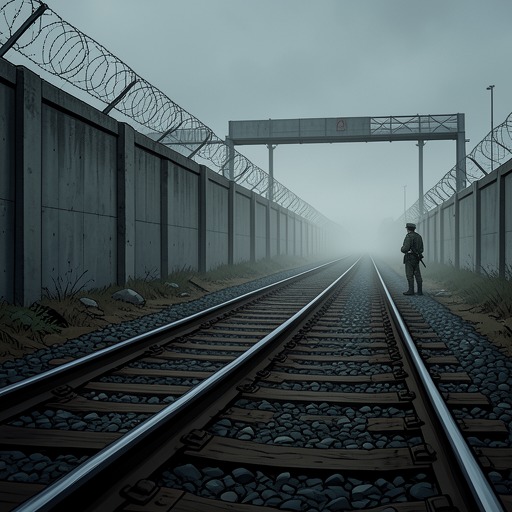
The agency appears through the testimony of Hyungchol Choi, its deputy director, who surveys the dry, hilly Demilitarized Zone from South Korea. The landscape contains deserted pillboxes, fading banners, and rusting barbed wire, while the heavily fortified border separates an open, internationally connected society from a closed state built around military readiness. The South Korean Central Intelligence Agency therefore occupies a strategic position between ordinary surveillance and national survival: its officers must interpret the North while outbreaks spread through the South.
The agency’s perspective is defined by accumulated intelligence practice. Its personnel know the North Korean border troops individually through years of photographs, nicknames, and dossiers recording their supposed ages, backgrounds, and personal lives. They also recognize the regular patterns of North Korean espionage, whose agents had once appeared with predictable frequency and were often identifiable through outdated clothing or ignorance of local prices. This institutional familiarity makes the later silence more disturbing, because it is measured against a detailed baseline rather than vague suspicion.
Detecting the Disappearance
About a month before the first reported outbreaks in Pusan, North Korea abruptly severed diplomatic relations and closed the rail line linking the two sides. The official explanation was only the familiar appeal to “matter of state security.” The South Korean Central Intelligence Agency did not initially interpret the move as a prelude to war: neither South Korean nor American satellite data showed hostile preparations, and there were no troop movements, aircraft fueling, or naval deployments.
Instead, the agency observed North Korean forces withdrawing from view. Border troops who had long been known to South Korean intelligence vanished behind shielded trenches and dugouts. At Panmunjom, where the two sides shared conference rooms and faced one another across an open courtyard, a North Korean detachment marched into its barracks one night; no replacement unit emerged. The doors closed, the lights went out, and the guards were never seen again.
The same pattern appeared throughout the agency’s human-intelligence network. North Korean spies, once nearly seasonal in their regularity, dwindled to nothing. South Korean agents operating inside the North also vanished at approximately the same time. Electronic surveillance assets went dark one by one: civilian and military channels ceased transmitting altogether, not merely producing alarming traffic. Satellite images showed fewer farmers in their fields, less movement on city streets, and fewer supposedly voluntary laborers at public works sites. From the Yalu River to the Demilitarized Zone, the intelligence picture became that of a country emptied of every living person.
Intelligence Under National Crisis
The agency’s assessment competed with political and military fears inside South Korea. As outbreaks struck Seoul, P’ohang, and Taejon, while Mokpo was evacuated and Kangnung isolated, South Korea also had to keep at least half its active divisions along the northern border. Officials in the Ministry of National Defense feared that Pyongyang was waiting for the country’s darkest moment before attacking across the 38th Parallel. The intelligence community rejected that interpretation, arguing that if the North had been waiting for South Korea to reach its weakest point, that point had already arrived.
This disagreement reveals the agency’s practical role. It does not possess a reassuring explanation; it possesses a disciplined refusal to mistake anxiety for evidence. The absence of troop movements, aircraft preparation, ship or submarine deployment, tunneling noise, espionage, and radio traffic all pointed away from conventional war. Yet the same evidence offered no account of what had happened inside North Korea, leaving the agency to report a disappearance rather than solve it.
Narrative Significance
The South Korean Central Intelligence Agency’s testimony makes intelligence itself a form of horror. Surveillance normally promises visibility and control, but here every instrument confirms only absence. The agency can identify the exact moment when familiar systems stop behaving normally, but it cannot see through the sealed trenches, closed barracks, or silent communications network. Its records transform the North Korean mystery from rumor into a structured sequence of failures.
The institution also sharpens the contrast between preparation and survival. North Korea had rivers, oceans, mountainous terrain, an underground military-industrial infrastructure, and a population portrayed as conditioned for obedience and war. By contrast, South Korea was an open, fractured society dependent on international trade and struggling to implement the Chang Doctrine during the Great Panic. The agency’s observations show that military preparedness alone cannot explain outcomes: the supposedly ideal survivor state vanishes before its neighboring intelligence service can determine why.
The organization’s decisive contribution is therefore epistemic rather than tactical. It preserves the distinction between what South Korea knows and what it merely fears. Its officers establish that North Korea’s disappearance was real, comprehensive, and temporally linked to the outbreak, while leaving the final cause unresolved. In a global narrative assembled from partial testimonies, that disciplined uncertainty becomes the agency’s lasting significance: it records the moment when a modern state ceases to be a visible political opponent and becomes an intelligence void.